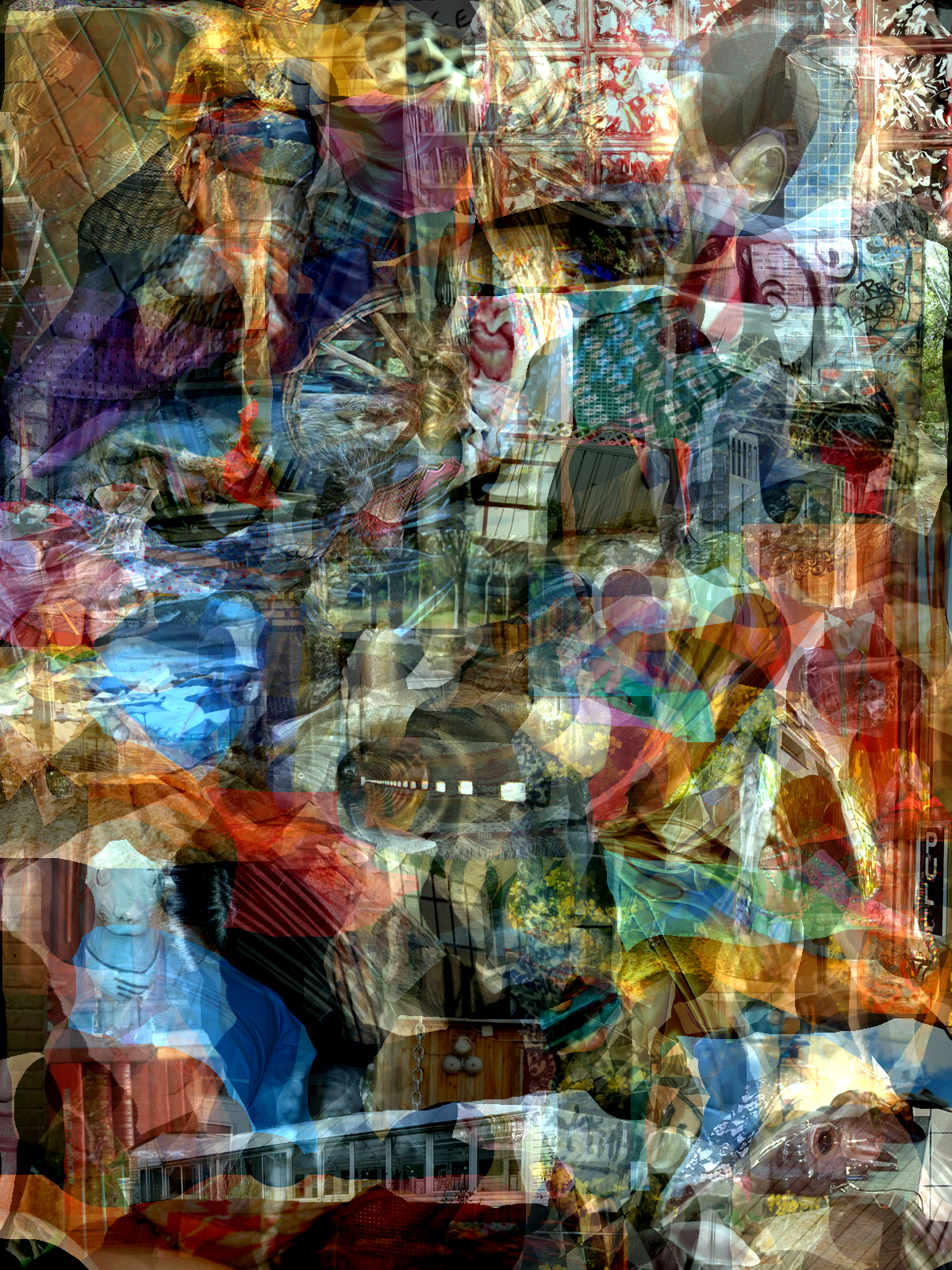
And so, we may wonder, what is to be done, or is being done, to counter the situation where the detritus of a society saturated with information becomes it's biggest problem, a problem impacting our ability to use communication to build community, a problem challenging our basic literacies and foundations of knowledge and authorship. The first step is to make affordances and allowance to digital creativity, readings that process, and in processing create resources for writings that advance new ways of rendering the info-waste into a a self-sustaining infosphere. As well, to protect the individual rights to productive use of the cultural commons as something loved, cherished, maintained for future re-generations, for the freedom to explore, to share, to reinvent. In such fashion we allow a bottom-up approach to revaluing cultural resources. Such wholescale changes must begin with education, a curriculum that draws straight from the world around it. Nothing new there--if one accepts the agenda put forward by the famous American educationalist John Dewey in Experience and Education (1938)--to derive a localized meaning from a globalizing phenomenon. But localized meaning in a virtual sense is personalized meaning. The strange discovery of self imagings among waste, the quasi-random self-witnessing available only when foreground value decays, when the polarizing focal point is obliterated, when only the background is brought to life, as it layers, decays to residual traces of meaning, where the gaze penetrates to the interior, as with a diamond, seeing into the image as an aggregate of vanishing transparencies washing over attention and tinting experience. A cosmic light only found in meditation flickers, the flowering timelapse. Glimpsed within, informational debris compresses, heats, reveals values that did not before exist, and offers a mode of seeing past temporal vision to the lasting conditions in the state of the mind--culminative, gelling awareness.
To promote the enhancement of our navigational strategies so that they may be regenerative beyond the greatest hits list-making of search engines we will be called toward a digital praxis that accommodates transfiguration, mutation, aesthetic discovery as much as it does the managerial pragmatics of structured arrays and databases. To do so we must forge a connection with the amibivalence of the bot, call it a mutual appreciation club. The bot lives on information as we do food. The code provides the bot with its destiny but information--input/output--is its fare. The bot can provide us with the means to make our horde of information valuable, viable compost for the knowledge vine as much as the for the data string. By intelligent software bots render, map, select, visualize the bitmap mass of texts, images, sounds. But we cannot leave teaching to bots. For teaching is the instutution by which society grows, addresses itself to what is as yet undetermined--the future world. We need to instill a profound awareness, to trust that beyond the obvious, and the odious, our greater meanings lie hidden. Turning the soil, the soul germinates and our learned offspring will require that inspiration if they are to find their way. Biblio/Wurdle