The vulnerability of the relay, as vulnerable as virtual selves exposed to the cyber-nautic wilds, to loss and dislocation as was Derrida's Postcard self to textual dismemberment, suggests the nightmarish vista of the road to data-waste, to the land of the dead letter. How does one come to researching waste, to seeing in that vulnerability a stronger resilience. I suppose there's a logic and a fetish quality to it. In “Old Forgotten Children’s Books’ (1924), Walter Benjamin observes that:
Children are fond of haunting any site where things are being visible worked on. They are irresistibly drawn by detritus generated by building, gardening, housework, carpentry, tailoring or whatever. In these waste products they recognize the face that the world of things turns directly and solely to them. In using these things they do not so much imitate the works of adults as bring together materials of widely different kinds in a new volatile relationship. Children thus produce their own small world of things within the larger one. The fairy-tale is such a waste product—perhaps the most powerful to be found in the spiritual life of humanity: a waste product that emerges from the growth and decay of saga. With the stuff of fairy-tales the child may be as sovereign and uninhibited as with rags and building blocks. Out of fairy-tale motifs the child constructs its world, or at least it forms a bond with these elements. (34)
The draw of something which is the useless excess of industry and production has charms that inspire children's minds just as the cottage industry, spoken of by Benjamin, does. Across North America there are not-for-profit organizations that collect up donations of off-cuts and excess, the waste and overproduction, and use these items with school children, structured into a wide variety of curricular activities, from science to visual art. They especially aid poorer schools, only charging a fee to those districts that can afford it. These bits of waste turn into valuable lessons not only in recycling and its effects on the imagination, but also in innovative uses for what is deemed junk. The imagination comes to life when a small world of useless things are given a new significance, a significance that is born into it through the act of reusing what has no other value, thus becoming value-added. Thus a non-prescribed value is authored and this has a lasting relationship with the notion of what gets called garbage. Don't turn your nose up at it's romantic resurrection, it mash-up rebirth.
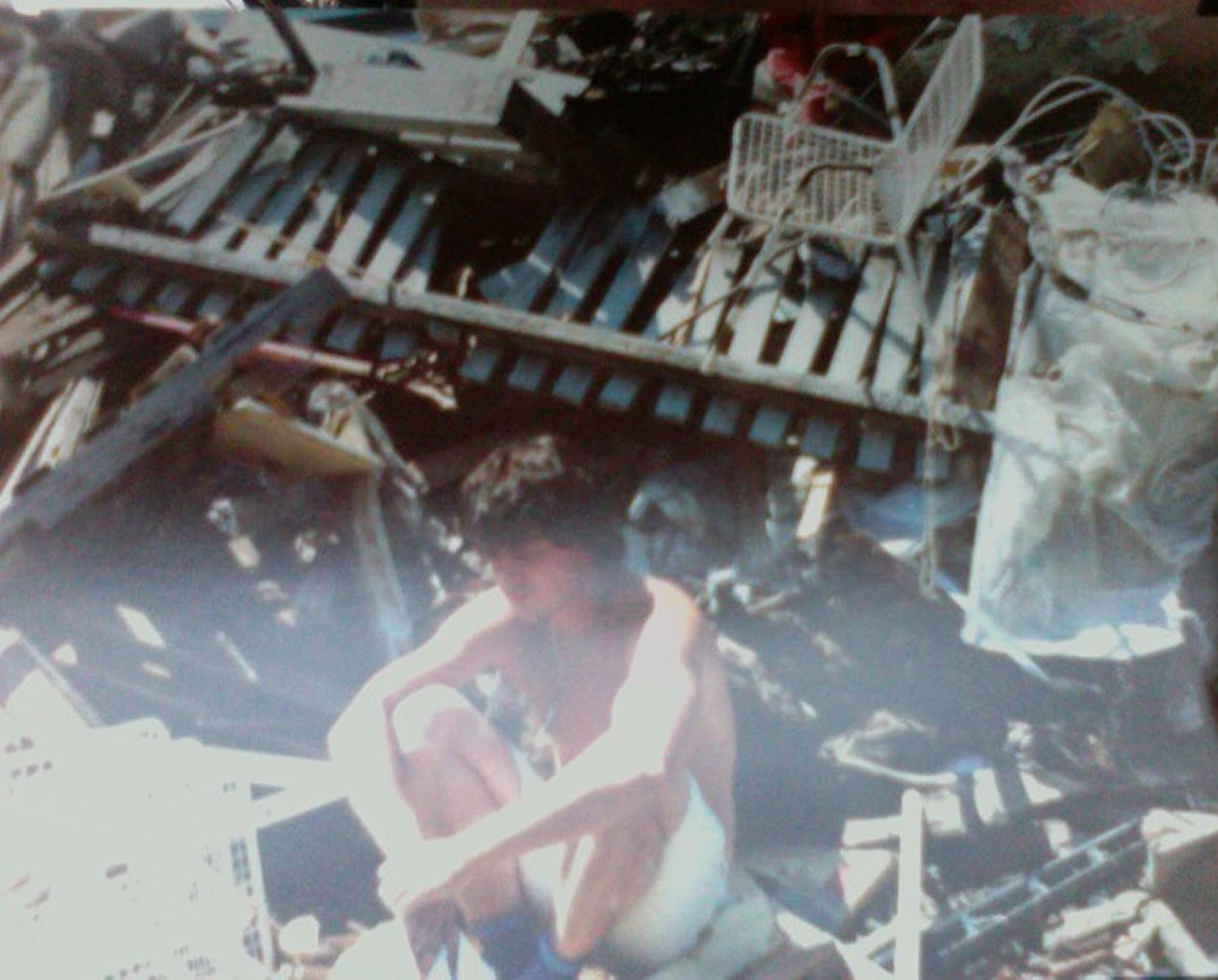
In 1985 my brother and I began a business, called unimaginatively K & G Site Service. We bought a one-ton truck and offered our service to construction site managers to collect their garbage and take it to the dump on a routine basis during the period of construction. It was not hard to find willing customers because waste is costly in construction and a hassle for companies that don't produce large enough amounts to warrant renting large bins. So every day we would go to construction sites, load up the waste and head off to the municipal landfill. At that time, there was less caution at the landfills. You paid by vehicle size, drove in, dumped your waste and left. Every so often we would take a pause during our day to adventure around the landfill, and inevitably we'd find some unlikely useful treasure, a brand new leather tool belt, an unopened box of records, an answering machine with all the tapes in it, a chandelier, and on and on. Below is a curious photo I took of my brother at the landfill, against a backdrop of what was a 10 meter high cliff of garbage, while he rests in that summer's hot afternoon sun.
Garbage represents the past. Even when something has never been used, to throw it out means to project it from the present, to historicize it, and separate it from the purpose, practicality, and utility. In this photo, I often imagine the figure of my twin as Humanity, ignoring the gigantic garbage wake that we produce in the course of consumerist lifestyles rising up just behind us. We are caught focusing entirely on the present and do not notice the environment we are leaving behind. The irony is that we encounter this past life of objét refusé in the future, our children's children will have to deal with it, as it revisits us in the form of environmental degradation–as it is already doing. This landfill is closed now, and the land sealed off from further use. The municipality's new dumping grounds have also been filled to brimming and are ready to be capped. The garbage is slated to be shipped to the United States, not that our neighbors don't produce enough of their own. They won't accept it. Now we have nowhere to discard waste. Next our discards become more valuable and costly too.
I suppose it's the same instinctual drive that motivates me which motivates the search for buried treasure, or motivates bargain and antique hunters and collectors of all things curious and collectable, each with its own systematizations, its aficionados, its average-Ebay-asking-price becoming the standard purchase value. However, Each said pastime/obsession condenses, disagregates, fertilizes with curiosity and attention, an aspect of the known world. Each commity of interest resurfaces value while interring non-knowledge through the celebration of the rare and one-of-a-kind item. This acts as necessary churning off the intellectual landfill just as much as the material cultural effluence. Waste has been a problem for millennia; strictly speaking, it entered civilization with the development of cities around the same time written language and counting systems did. Yet we've experienced an unprecedented historical period of wasteful abundance. No doubt this will impact both environments--material and intellectual--but we have no strict measure of how it impacts the information environments. We need a new fairy tale.
A fetish for garbage is not new, take for example the eighteenth-century Parisian flaneur, a rag-picker finding linen for turning into paper before wood pulp replaced it--and for Benjamin (1999) the champion gleaner, Baudillare, drawing from the filthy public streets the essence of an age. In contemporary North America, second-hand and consignment stores, flea markets, swap meets, yard and garage sales, street markets, institutional fundraisers. The gleaners, the treasure-hunters, the aficionados and automated sorters descend: Every domain of post-cultural production has its avid attendees, those who scour the excess for value. It would be amiss not to mention, as importantly, used book and record stores, coin and stamp dealerships, collectors conventions, auctions, and the myriad points of highly specialized exchange, each with its special language, it's lexicon of minutiae that distinguish collections. And collection worth its salt combines those items that were purchased as a regular fan might with those that were specialty purchased, those traded for, and those magical ones that were found in the effluence, a nugget in a gold pan. Those same nuggets often get collections started, initiate the interest that when nurished and systematized, became expertise.
The point at which the seemingly mundane or even valueless object transforms into a precious and coveted object requires an appointment of imagination; curiosity drives the navigator to explore the unknown, the unpredictable territory extending beyond the mindmap. Navigating the ocean of information is not a passive form of discovery; the Internet is filled with gems--but they are hard to find, and often sharing--that richest of textual practices--is criminalized. The reward for the collector is the point of absorption in the object, or text, the re-evaluation that, once performed, echoes over a lifetime. The collector, as Baudrillard (1999) presents this phenomenon, requires a valorization of that which eschews utility and participates instead in the non-functional system of objects. This system ritually sanctifies the object as resistant to time, and worthy of absorption, the attention value required for a fetish. Baudrillard reads this as a point of authorship and authority in the world of objects. Benjamin, on the other hand, resuscitated the informational dump to uncover the cultural history, the energetic past, of 19th Century Paris. In this way, Benjamin is the more fetishistic, but also able, therefore, to position waste within the concern about specialization, in knowledge as a form of collection, the repo man, Benjamin worked to recover the informational past for the cultural present through pursuing, gleaning, codifying and synthesizing. He tolerated informational detritus, and discovered the joy of autopoesis on the journey.
I am just "sorting it out" as the saying goes. Yet I sense the evolution of a new learning style in these processes of navigating excess. It's even apparent in the appreciation of automated digital art where cumulative moments, the urgent element of discovery, of rare treasures, significant glitches in the processing of information, translate between the hoary cells and silicon circuits. Here I am brazenly defending the romantic spirit, arising from the muck of existence—poet, pirate, and netbot, charmed outcasts, vital to culture’s continual relevance, to the painful joy of believing in magical synchronicity, in fortuitous pursuits of data dredging. I would go further askew, summoning nostalgia for lost relevancies, not the big answer but an infinite number of small meanings, tremendously powerful, like fairytale mice. Last Page