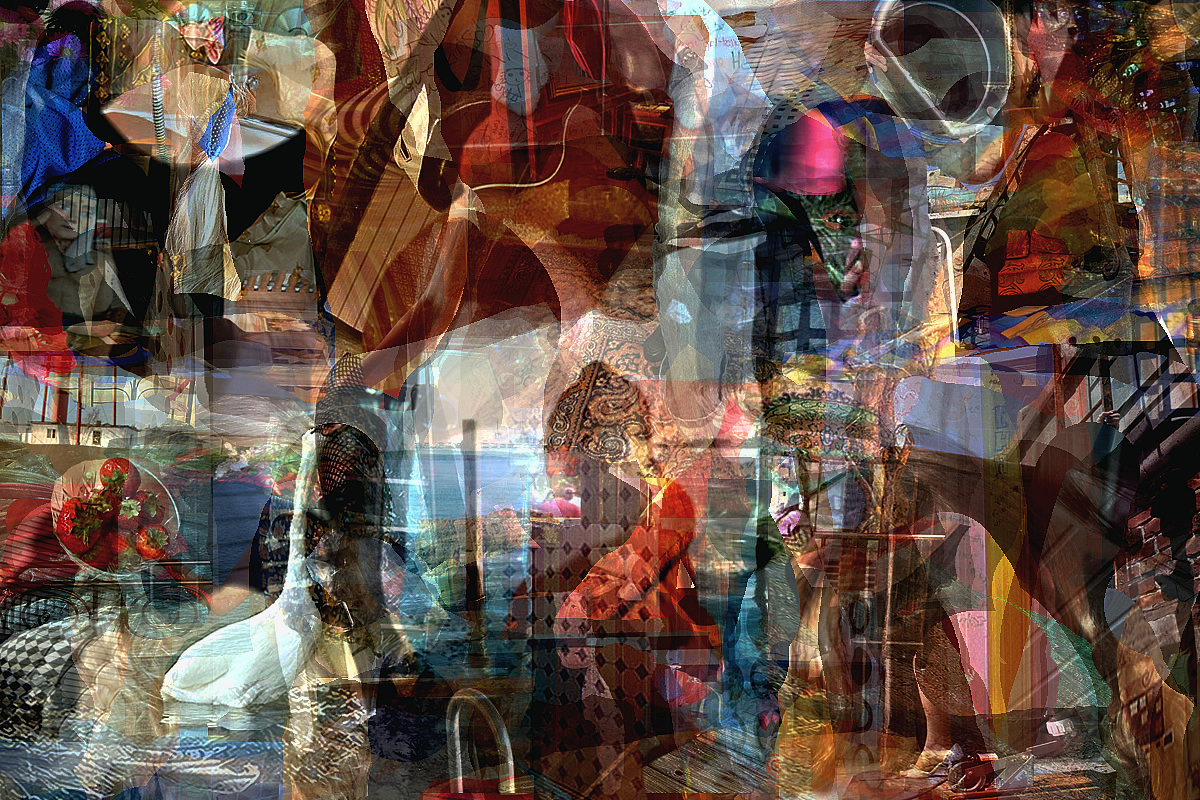
Sometimes those who have been on Death's threshold say "my life passed before my eyes". The experience, one that has been played out many times in movies, could only be described visually. Life cannot pass before the ears, because the ears are forever connected to the present location in space and time. Sounds become meaningless when sped up well past the frequencies recorded. Speeding up sound to the point of a life's worth of listening recurring in a critical moment of existence is utterly unfeasible. It would be well beyond the range of hearing, and one would need Xray ears. But one may composite moments into a stilllife only with transparencies, the montage of sound advances, the montage of images retreats, becomes literally still life. Vision by its nature is fleeting. This idea that life could be so witnessed, compressed into a moment, is an extreme form of aesthetic compression of meaning. It is no less aesthetic because it is motivated by crisis. It is the crisis which strips the normative dimension of contemplation, one which greatly enchanted the aesthetic philosophy of Emanuel Kant, from the act of witnessing one's life in its non-synchronous totality. The ultimate sum of all things learned, in an imploded scope and sequence, the curriculum of a life.
There are methods of looking into the residue of meaning crystalized from life's experiences. Literture and the arts have long served this basic cultural purpose of condensing experience into imbued expression. New technologies have made possible the increased participation of the public in mediated life, both as consumers and producers of culture. Some have taken to living in the data-stream, whether through blogging daily life, putting a webcam in one's domestic space, creating homebrewed TV series on YouTube, or at the upper eschelons of Microsoft corporations, the technoprophets contend that it might be possible to record and store the record of one's entire existence. The idea that we might live on, through the animation of our life's data, has obsessed many writers, and while these narratives still the stuff of science fiction, humans will not stop from trying. What would you code? Is there a way to encode everything of an experience, a life, thus to animate it in digital form? And if there were, would you want it done to you? Just how selective would you be?
While I hold with sceptics on the viability of uploading oneself to botdom, I do think these question are worth asking. Underneath the questions is a deeper question, one to do with the concept and function of the author. We must write our data. How to do so? Is the technology of recording so fantastic as to be transparent, and have no say of its own? There are risks and pleasures of becoming self-authoring. There are two great challenges, one, what to put in, and in what style (shall we say format?) to put it in, the other, what to leave out of the narrative. Life writing implies both, that which is encoded, and that which is not. But is the unencoded not present, as the obliterated context of codified information, and the hidden metanarrative behind decisions and choices made regarding what is encoded? Is the metadata meaningless, even if it appears insignificant? Codes, and therefore data, also have genres, structures constraints, impositions. As a vitual person, we might also have styles of navigating and interactng with other virtual life forms. And what if that virtual environment, now experienced as pure data, free from the debilitations of user interfaces, were so polluted and filled with harmful viruses and aggressive scripts that virtual life were constantly threatened and under attack, decompostion, corruption, even zombified control by automatons? If the botnets on the web today are capable of doing this with PC computers, why not with PC persons?
It is not a disembodied set of principles that passes before the eyes, but rather the moments of causative ephemera that over time settle into the background information that governs identity and self in the world, a narrative curriculum of self knowledge, presented not on the axis of sequence, but on the axis of combination, to borrow these terms from Roman Jakobson (1981). This is the same axis on which the poetic functions of language are encountered, those which directly access the residual meaning potential embedded in language or other codified systems. These residual experiences inform tacit attitudes and comprehension, inform what is given information, and what is new. They energize meaning-potential. In order to reach this height of compression of information, much that at one time ranked as significant to the individual must now be obliterated in favor of aesthetic selection mid crisis, a process governed by the heightened residual life-charge of certain data-caches over others. Next page