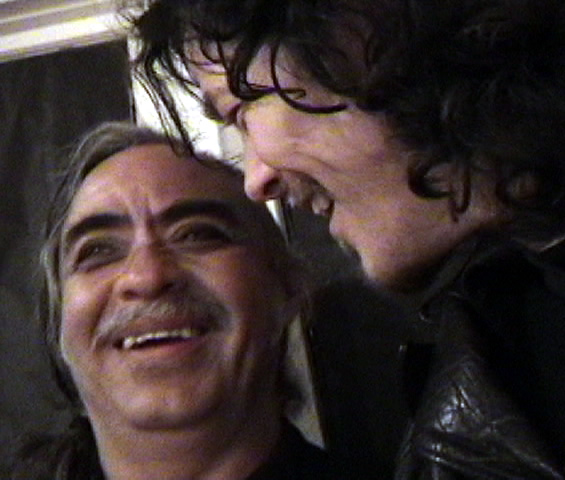
I was recently (April 2006) hanging out with Guillermo Gomez Pena, who is for me first and formost a teacher. GGP continues to make the kind of art that few are daring and willing to do. And he performs this art with enormous compassion. He has a non-profit society, Pocha Nostra. They are involved in a kind of radical pedagogy and cultural activism for the streets, for the classroom, for the civilization. This pedagogical turn drew him to Galiano Island, where he had been commissioned to direct a performance by an all first nation women's theater group, the Turtle Gals. I showed up on a friday night at the community center, after catching the rush hour bus and traveling out to the ferry terminal. But it was a quick run, and I was on the Island in under three hours. I got picked up by one of the assistants working with Marie, the red ink director, a non-profit society that arranges for groups of artists to stay and workshop and perfom their new works at the local community center. He had mentioned the show to me while spending an evening at the house of Elaine Katzenberger, editor of City Lights books in San Francisco, just a couple weeks before when I was attending the American Educational Research Association's annual general meeting. We had the opportunity to discuss aspects of his approach to Radical Pedagogy in both these meetings, although our conversation is liberally dosed with free-ranging stories
.
Gomez Pena's last few years have been devoted to touring all over the world, setting up his particular brand of living dioramas in the worlds famous museums, like the Smithsonian, and gallerys, like the Tate. Always he works a provocative line and border, challenging people to exist in a way that they confront what is happening in their personal version of human relations. He performs and conjures every taboo stereotype there is, and puts it in a blender of language, image, symbol, sexiness, music, movie, and distills, in the process, impressions that crystalize permanently in the psyche. He reduces the inner hallucination of conformity to a staring contest between itself and the other, and the other, whether live, photogenetic, in print or on video, also wins. Note to poetry fans: in 1990, coming back from a tour in the U.S. I walked into Elliot Bay book store and this book, called Warrior of Gringostroika was face out and I picked it up. I was already interested then in writing which uses multiple languages or made up tongues. This book was doing both, in an irreverent yet deeply political way. I bought it, a new book, sort of as a momento of Seattle and the U.S. tour, but also because I felt guided to it. I later sought him out, and turned others onto GGP as well. We were almost instantly friends, and his work has deeply affected mine. This moral of the story is to follow up on impulses especially what you encounter as poetry. If you find a book of interest, spend the coin, find out more, seek that writer out, just so that you can know them for who they are. The rewards are worth any potential fear of rejection that might hinder your jouney. It may not be GGP, he is a rare find indeed, but it might be someone just as important to your life and your work as he is to me and mine.