The Leningrad Codex
Biblical Manuscripts: The Leningrad
Codex
The Leningrad Codex, or Leningradensis, is the
oldest complete Hebrew bible still preserved. While there are older parts of
Bibles, or biblical books, still in existence, there is no older manuscript
which contains the whole Hebrew Bible (or Old Testament in Hebrew). The
Leningrad Codex is considered one of the best examples of the Masoretic text.
How Old is the Manuscript?
The manuscript was written around the year 1010 C. E. It was
probably written in Cairo, and later sold to someone living in Damascus.
What do we mean when we talk about the Masoretic Text?
This manuscript belongs to a group of Hebrew texts called the
Masoretic texts. The Hebrew alphabet itself, which developed from the
Phoenician alphabet, has no true vowels, so the oldest Hebrew biblical
fragments have only consonants, some of which are used as half-vowels, like our
y, w, and hä.
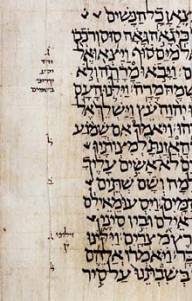
The Masoretes were also interested in copying the biblical text
very carefully so that it would be preserved from generation to generation. The
way they tried to ensure this was the use of notes in the margins. In the
margins beside the biblical verses they put little letters as symbols. These
symbols told the scribe copying the text information about unusual forms or
words that should not be changed. For instance, they might put a circle over a
word that occurred nowhere else in the Bible. In the margin they would then put
the letter "l" which told the scribe, "yes, this is a unique
word, but it is not an error, so just copy it the way it is." The notes at
the top or bottom of a page would usually give more information about the
symbols in the side margins.
What is a Codex?
The Leningrad Bible is called a "Codex" because it is in
the form of a book ("codex" being an old word for "book").
The Bibles in the synagogues were in the form of scrolls, which meant that one
never had an entire Bible together in one scroll. The codex would not have been
used in the synagogue, but would have been used as a study Bible by students
and scholars.
--Marilyn J. Lundberg
(Photograph by Bruce and Kenneth Zuckerman, West Semitic Research in collaboration with the Ancient Biblical Manuscript Center)