Introduction to the Nag Hammadi
Library
Page
of a Coptic Codex
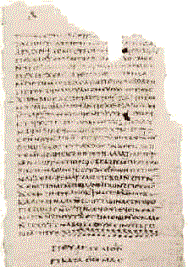
The Gospel of Thomas, one of the Gnostic texts
found preserved in the Nag Hammadi Library, gives these words of the living
Jesus:
≥Jesus said, `I am not your master. Because you have drunk, you
have become drunk from the bubbling stream which I have measured out.... He who
will drink from my mouth will become as I am: I myself shall become he, and the
things that are hidden will be revealed to him.'≤
He who will drink from my mouth will become as I am: What a
remarkably heretical image! The Gospel of Thomas, from which
we take that text, is an extraordinary scripture. Professor Helmut Koester of
Harvard University notes that though ultimately this Gospel was condemned
and destroyed by the evolving orthodox church, it may be
as old or older than the four canonical gospels preserved, and even have served
as a source document to them. This brings us to the third prominent element in
our brief summary of Gnosticism: its reverence for texts and scriptures
unaccepted by the orthodox fold. The Gnostic experience was mythopoetic -- in
story and allegory, and perhaps also in ritual enactments, Gnosticism sought
expression of subtle, visionary insights inexpressible by rational proposition
or dogmatic affirmation.
For the Gnostics, revelation was the nature of Gnosis: and for all
the visions vouchsafed them, they affirmed a certainty that God would yet
reveal many great and wonderful things. Irritated by their profusion of
"inspired texts" and myths--most particularly their penchant for
amplifying the story of Adam and Eve, and of the spiritual creation which they
viewed as preceding the material realization of creation--Ireneaus complains in
his classic second century refutation of Gnosticism, that ≥every one of them
generates something new, day by day, according to his ability; for no one is
deemed perfect [or, mature], who does not develop...some mighty fiction.≤
-- Lance S. Owens