THE
WRITINGS BY ST. PAUL AND THE
INTERPRETATION
OF THE REFORMATION
THE ASCETIC IDEAL AND THE NEW
TESTAMENT
The
writings by or attributed to St. Paul form a critical point in the entire great
divide between the churches of the Reformation and the Orthodox and Roman
Catholic Church. The Epistle to the Romans is one of the most
important references of this controversy.
 The rejection of
monasticism ultimately followed from the emphasis placed upon salvation as a
free gift of God. Such a position is completely accurate but its specific
understanding
The rejection of
monasticism ultimately followed from the emphasis placed upon salvation as a
free gift of God. Such a position is completely accurate but its specific
understanding
was
entirely contrary to that of the early Church.
St. Paul (with
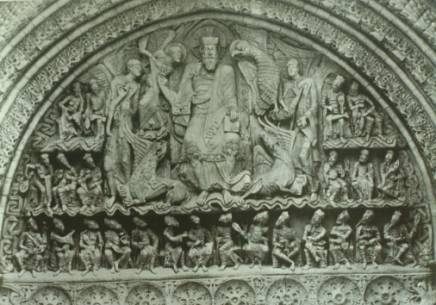
book) Western Gate of the Moissac Monastery
St.
Paul writes (2:6) that God "will render to each according to his
works." If St. Paul was so concerned about the word "works," if
he feared that the Christian readers of his letter might interpret
"works" in some totally different way from what he intended, he
certainly could have been more cautious. But St. Paul clearly distinguishes
between the "works" of the Judaic law and the "works" of
the Holy Spirit required of all Christians. Hence, it is difficult to confuse
these two perspectives and it is significant that the early Church never
confused them, for they understood what St. Paul wrote. If anythingãdespite the
lucidity of St. Paulπs thoughtãthere were tendencies at times to fall not into
Lutherπs one-sided interpretation but rather to fall somewhat spontaneously
into an Eros-type of striving.
The
Collected Works of Georges Florovsky, Vol. X, The Byzantine Ascetic and Spiritual
Fathers
(Vaduz, Europa: Buchervertriebsanstalt, 1987).