Discovery of the Nag Hammadi Library
It was on a December day in the year of 1945, near the town of Nag
Hammadi in Upper Egypt, that the course of Gnostic studies was radically
renewed and forever changed. An Arab peasant, digging around a boulder in search
of fertilizer for his fields, happened that day upon an old, rather large red
earthenware jar. Hoping to have found buried treasure, and with due hesitation
and apprehension about the jinn, the genie or spirit who might attend
such an hoard, he smashed the jar open with his pick. Inside he discovered no
treasure and no genie, but books: more than a dozen old papyrus books, bound in
golden brown leather. Little did he realize that he had found an extraordinary
collection of ancient texts, manuscripts hidden up a millennium and a half
before (probably deposited in the jar around the year 390 by monks from the
nearby monastery of St. Pachomius) to escape destruction under order of the
emerging orthodox Church in its violent expunging of all heterodoxy and heresy.
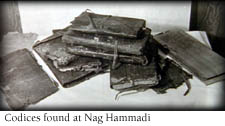
How the Nag Hammadi manuscripts eventually passed into scholarly
hands, is a fascinating even if too lengthy story to here relate. But today,
now fifty years since being unearthed and more than two decades after final
translation and publication in English as The Nag Hammadi Library, their
importance has become astoundingly clear: These thirteen beautiful papyrus
codices containing fifty-two sacred texts are the long lost "Gnostic
Gospels", a last extant testament of what orthodox Christianity perceived
to be its most dangerous and insidious challenge, the feared opponent that the
Patristic heresiologists had reviled under many different names, but most
commonly as Gnosticism. The discovery of these documents has radically revised
our understanding of Gnosticism and the early Christian church.
-- Lance S. Owens