Allegro, John M. The Dead Sea Scrolls and the Christian Myth. Prometheus Books, New York. 1992
The Dead Sea Scrolls
In 1947 a young Arab shepherd had followed a straying animal from his flock up a steep hill on the western side of the Dead Sea. He came upon a cave containing several tall earthenware jars, in which were seven parchment scrolls in varying states of preservation. The largest turned out to be a copy of the biblical book of Isaiah, dating probably to the first or second century before the turn of the era, a thousand years or so older than any Hebrew manuscript of the Old Testament then known. (Allegro, p. xiv)
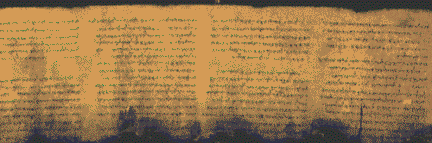
A mile or so away from the first cave were the tumbled down and dust-strewn remains of an ancient settlement, long noticed but never before investigated. This site was excavated over the next five seasons and turned out to be the Essene Monastery whose existence by the shores of the Dead Sea had been noted by Pliny in the first century. The workmen employed for the excavation included local Bedouin shepherds. Showing more resourcefulness and imagination than their employers, they searched the immediate vicinity in their spare time and in 1952 found a chamber artificially hollowed out of the marly plateau on which the settlement was sited. In the absence of the archeologists, the Bedouins scrambled in the dust chamber floor and soon came upon tens of thousands of manuscript fragments of parchment and papyrusãthe remains as it subsequently transpired, of some four hundred different documents of the Essene Library. In this case, presumably because danger from attack threatened the monastery, the inhabitants had torn up their precious scrolls and thrown them into the chamber they had previously prepared, perhaps just for this kind of emergency, and left them to rot. So while the first scrolls were comparatively well preserved, having been stored in jars and wrapped about in linen for the two thousand intervening years, these small fragments, many no larger than a fingernail, have had to be individually cleaned, photographed, painstakingly pieced together as far a possible, identified, though usually out of literary context, and then edited for publication. (Allegro, p .xvi)
The (Dead Sea) Scrolls are for the most part written in Hebrew or Aramaic, the Semitic tongues used in contemporary Palestine; the New Testament is in Greek meaning that underlying Jewish conceptions have been translated out of their native forms of expression into the language of the majority of the Churchπs non-Palestinian, and largely non-Jewish, adherents. To make adequate comparison, the scholar must try to reconstruct the underlying word or phrase in its original Semitic form, and thus assess its likely meaning in the original context. In other words, insofar as New Testament Ideas are of Jewish origin, their form as presented by the gentile Church is second-hand, and probably distorted. (Allegro p.13-14)
≥äthe scrolls were written mainly between the beginning of the first century BC and the first half of the first century ADä (Allegro, p. 14)
The Gospel stories that have come down to us in the New Testament canon are, of course, only a small part of the mythical literature circulating in the various messianic sects which proliferated after the disruption of the Essene central administration in AD68. It is clear that the so-called Great Church early on purged the story of elements it considered unsuitable, or would hinder its movementπs acceptance by authorities, Jewish and Roman, who threatened its survival. (Allegro. P. 134)