CATHOLIC ENCYCLOPEDIA: Censorship of
Books
Censorship
of Books
(Censura
Librorum.)
Although
the censorship of books (in the wider sense) did not begin precisely with the
invention and spread of the art of printing, yet in our definition of it, only
productions of the press are spoken of. In the first place, censorship now, as
well as in centuries past, is concerned exclusively with printed works;
secondly, in the narrower sense (censura prÊvia), it has taken that
definite form, which is expressed by "censorship of books," only
after the invention of the printing press. When explaining, however, the
historical development of censorship, we must begin with an earlier period,
because we are here dealing with it as exercised by the Universal Church of
Rome. From the beginning and at all times in principle, the Church adhered to
the censorship, although in the course of time the application was modified
according to conditions and circumstances.
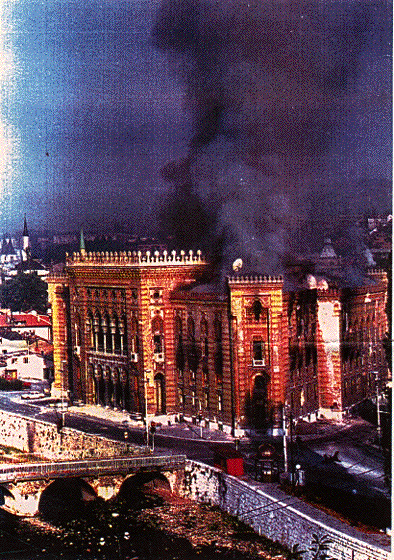
August 25, 1992 National and
University Library of Bosnia
HISTORICAL
DEVELOPMENT
As
soon as there were books or writing of any kind the spreading or reading of
which was highly detrimental to the public, competent authorities were obliged
to take measures against them. Long before the Christian era, therefore, we find
that heathens as well as Jews had fixed regulations for the suppression of
dangerous books and the prevention of corruptive reading. From numerous
illustrations quoted by Zaccaria (pp. 248-256) it is evident that most of the
writings condemned or destroyed offended against religion and morals.
Everywhere the books declared dangerous were cast into the fire--the simplest
and most natural execution of censorship. When at Ephesus, in consequence of
St. Paul's preaching, the heathens were converted, they raised before the eyes
of the Apostle of the Gentiles a pile in order to burn their numerous
superstition books (Acts, xix, 19). No doubt, the new Christians moved by grace
and the Apostolic word did so of their own accord; but all the more was their
action approved by St. Paul himself, and it is recorded as an example worthy of
imitation by the author of the Acts of the Apostles. From this burning of the
books at Ephesus, as well as from the Second Epistle of St. Peter and the
Epistles of St. Paul to Timothy and Titus, it clearly appears how the Apostles
judged of pernicious books and how they wished them to be treated. In concert
with the Apostle of the Gentiles (Tit., iii, 10). St. John most emphatically
exhorted the first Christians to shun heretical teachers. To the disciples of
the Apostles it was a matter of course to connect this warning not only with
the persons of such teachers, but first and foremost with their doctrine and
their writings. Thus, in the first Christian centuries, the so-called apocrypha
(q.v.) above all other books appeared to the faithful as libri non
recipiendi, books which were on no account to be used. The establishment of
the Canon of Holy Writ was, therefore, at once an elimination and a censuring
of the apocrypha. The two documents referring to this, both from the latter
half of the second century, are the Muratorian Canon (q.v.) and the Apostolic
Constitutions (see Hauler, DidascaliÊ Apostolorum fragments, Leipzig, 1900, p.
4).
When
the Church, after the era of persecution, was given greater liberty, a
censorship of books appears more plainly. The First Ecumenical Council of NicÊa
(325) condemned not only Arius personally, but also his book entitled
"Thalia"; Constantine commanded that the writings of Arius and his
friends should everywhere be delivered up to be burned; concealment of them was
forbidden under pain of death. In the following centuries, when and wherever
heresies sprung up, the popes of Rome and the oecumenical councils, as well as
the particular synods of Africa, Asia, and Europe, condemned, conjointly with
the false doctrines, the books and writings containing them. (Cf. Hilgers, Die
B¸cherverbote in Papstbriefen.) The latter were ordered to be destroyed by
fire, and illegal preservation of them was treated as a heinous criminal
offense. The authorities intended to make the reading of such writings simply
impossible. Pope St. Innocent I, enumerating in a letter of 405 a number of apocryphal
writings, rejects them as non solum repudianda sed etiam damnanda. It is the first
attempt at a catalog of forbidden books. The so-called "Decretum
Gelasianum" contains many more, not only apocryphal,but also heretical, or
otherwise objectionable writings. It is not without reason that this catalog
has been called the first "Roman Index" of forbidden books.
JOSEPH
HILGERS
Transcribed
by M. Donahue
The Catholic
Encyclopedia, Volume III
Copyright © 1908
by Robert Appleton Company
Online Edition
Copyright © 1999 by Kevin Knight
Nihil Obstat,
November 1, 1908. Remy
Lafort, S.T.D., Censor
Imprimatur. +John Cardinal Farley, Archbishop of New
York